Thick Fabric Does Not Make a Strong Bag — It Buys Wearing Time
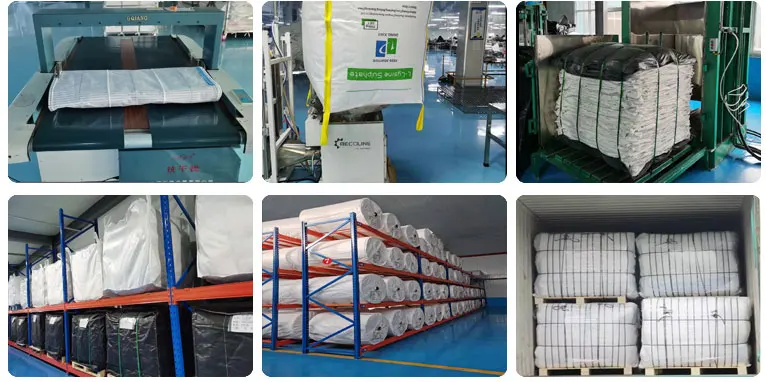
Buyers often ask for "thicker bags" as if thickness were a single dial that raises every property at once. It is not. Fabric weight buys one specific thing: an allowance for material that will be worn, punctured or scuffed away before the bag reaches the end of its service. That allowance is real and valuable, especially for mineral cargo with sharp edges. But thickening the body also moves the weak point somewhere else — to the seam that was not upgraded with it, to the loop attachment, or to the base corner where the mass of the load concentrates. Thickened wear-resistant FIBC bulk bags for chemical and mineral powder export are engineered around this budget: extra material where abrasion actually happens, and matched strength everywhere else so that the bag fails nowhere first.
Two Cargoes That Wear a Bag in Completely Different Ways
Chemical powder and mineral powder are both "bulk," and they damage packaging by opposite mechanisms. Specifying a bag for one and expecting it to serve the other is a common source of field failures.
Minerals: Sharp Edges and Point Loads
Mineral cargo arrives as angular particles — crushed stone, ore, sand, talc, barytes. When the bag is filled, those edges press against the inner fabric with concentrated point loads. When it is lifted, the load compresses downward and outward, driving edges into the base and lower walls. When it is dragged across concrete, stacked on pallet edges or handled roughly in a container, the outer surface abrades. Mineral wear is therefore mechanical, progressive and concentrated in specific zones: the base, the lower third of the walls, the corners, and any area in contact with handling equipment.
Chemical Powder: Abrasive Slurry at the Seams
Fine chemical powder behaves differently. Individual particles are small, but moving powder acts like a mild abrasive fluid. Under vibration in transit, it works its way into seam gaps, coating interfaces and closure folds, abrading from the inside while staying invisible from outside. Add hygroscopic behavior — powder absorbing moisture, caking and pressing against fabric — and chemical cargo stresses the bag at its joints rather than at its broad surfaces.
The practical consequence: a bag that performs well with minerals may leak with fine chemicals, because the failure mechanisms do not overlap.
What Thickness Buys, and What It Cannot Buy
An increase in fabric weight per square metre delivers four concrete benefits, and buyers should be clear about which one they are paying for.
-
Abrasion allowance: more material to lose before the fabric becomes permeable or weak.
-
Puncture resistance: greater resistance to sharp mineral edges and to handling contact.
-
Tear propagation resistance: a heavier woven structure slows the growth of a nick into a split.
-
UV margin: thicker fabric retains usable strength for longer when exposed outdoors, because the degraded surface layer represents a smaller fraction of the total.
What thickness cannot buy is seam strength, loop attachment capacity, coating integrity or closure reliability. Those are separate specifications, and they do not increase automatically when the fabric gets heavier — in fact a heavy fabric can load a standard seam harder than before.
Where the Weak Point Moves
When a body fabric is upgraded without matching the rest of the construction, failures migrate to predictable locations.
Seams That No Longer Match the Fabric
A stitching pattern sized for lighter fabric may not carry the same load when the body is heavier and the filled weight higher. Seam efficiency should be specified as a ratio of seam strength to fabric strength, not as an independent number, so the joint does not become the intentional weak link.
Loop and Base Attachment Points
Lifting loops concentrate the entire load of a tonne or more into a small sewn area. Heavier fabric increases the load the attachment must transfer. Loop webbing, stitch count and reinforcement patches need to be re-specified together with any body upgrade.
Coating Cracks and Needle Holes
Where a coated fabric is used for moisture resistance, a thicker substrate can crack its coating under flex if the coating was not formulated for the extra stiffness. Every sewing needle hole is also a potential moisture path, which is why coated constructions need seam sealing rather than plain stitching.
Tare Weight: The Cost Nobody Puts in the Quotation
Extra fabric is paid for twice. First in the price of the bag, and second in freight, because the bag's own weight travels with the cargo. In a container loaded with one-tonne bags, the accumulated tare of the packaging reduces the payload that can be shipped, and in air or parcel freight the effect is more pronounced. The right question is never "how thick can we make it," but "how much thickness does this cargo and this route actually consume — and how much more is pure cost?"
A sensible specification sets thickness from the abrasion environment and the number of trips the bag must survive, then confirms the resulting tare against the freight economics of the route.
Wear Sources, Mechanisms and Design Responses
|
Wear Source
|
Mechanism
|
Design Response
|
|
Sharp mineral edges
|
Point loads puncture and thin the fabric
|
Higher fabric weight, dense weave, puncture-resistant liner
|
|
Base and corner contact
|
Dragging and pallet edges abrade the surface
|
Reinforced base, corner patches, heavier lower zone
|
|
Vibration in transit
|
Fine powder abrades seams from inside
|
Sift-proof seams, sealed stitching, liner barrier
|
|
Repeated lifting
|
Load concentrates at loop attachments
|
Matched loop webbing and reinforcement
|
|
Outdoor exposure
|
UV degrades surface strength
|
In-melt UV stabilization, thickness margin
|
Specifying and Verifying a Wear-resistant Heavy-duty Bag
-
Describe the cargo: particle shape, bulk density, moisture sensitivity and chemical compatibility.
-
Set fabric weight from the abrasion environment and required number of trips, not by habit.
-
Require seam strength as a ratio to fabric strength, plus loop and base reinforcement data.
-
Confirm the safety factor for the full filled weight and the intended lift method.
-
Request abrasion, drop and puncture test evidence, and UV strength retention if stored outdoors.
-
Weigh the resulting tare and check it against your freight payload calculation.
Conclusion
Thickened wear-resistant FIBC bulk bags are a heavy-duty answer for chemical and mineral powder export, but the logic behind them is a wearing budget rather than a simple dial for strength. Mineral cargo consumes that budget through sharp edges, point loads and surface abrasion; fine chemical powder consumes it at seams and joints under vibration. Fabric weight buys abrasion allowance, puncture resistance, tear resistance and UV margin — while seams, loops and coatings must be upgraded with it or they become the next failure point. And every kilogram of added fabric travels with the cargo as tare weight. Buyers who specify thickness from the actual wear environment and match the rest of the construction to it get durability where it is needed, instead of cost where it is not.