FIBC bulk bags are the most widely used container for large-volume bulk solid storage, handling and cross-regional logistics. While most FIBC damage incidents are attributed to low-quality fabric or poor manufacturing, the majority of field failures stem from improper operation, mismatched packaging configuration, overlooked environmental erosion and unoptimized loading manners. Minor FIBC damage can cause material leakage, production suspension and cargo loss, while severe structural failure may lead to falling loads, workplace safety accidents and compliance penalties. Establishing a complete FIBC risk prevention system that targets real damaging causes and adopts standardized protective solutions helps factories and logistics teams reduce bag failure rates, stabilize operational safety and cut hidden logistics costs effectively.
Hidden Operational Causes of FIBC Damage in Industrial Scenarios
Different from obvious quality defects, most daily FIBC damage comes from long-term cumulative fatigue and irregular handling behaviors that are easily ignored by on-site teams. These subtle unsafe practices gradually weaken fabric strength, loosen stitching structure and damage lifting components, eventually causing sudden failure during stacking or transportation.
Overfilling and asymmetric loading is one of the top invisible causes. Many operators fill FIBCs beyond rated capacity to improve shipment efficiency. Overfilling leads to excessive lateral expansion and vertical tension, putting continuous overload pressure on sidewalls, bottom seams and lifting loops. Meanwhile, uneven material distribution causes unbalanced gravity center, resulting in tilted stress during lifting and local stitch tearing that cannot be observed in static state.
Mechanical irregular handling also accelerates FIBC aging and damage. Common improper operations include forklift sharp corner scratching, dragging full bags on the ground, violent hoisting and rapid dropping during placement. Even tiny fabric scratches will expand rapidly under stacking pressure and vibration, evolving into large-area rupture and powder leakage during long-distance transit.
Uncontrolled environmental erosion is easily overlooked in daily management. Long-term outdoor UV exposure weakens PP molecular activity, making fabrics brittle and easy to crack. Continuous rainwater soaking, high humidity and salt fog corrosion damage stitching thread toughness, causing invisible seam loosening. Dust and abrasive particle residue between stacking layers also produce friction wear during transportation vibration.
Material and Structural Matching Risks Leading to Premature FIBC Failure
A large number of FIBC damage cases are caused by mismatched material configuration rather than poor bag quality. Using universal standard FIBCs for special bulk materials will trigger targeted structural damage, forming repeated loss problems that are difficult to solve through routine inspection.
For abrasive mineral and hard granular materials, ordinary uncoated FIBCs lack anti-wear protection. Sharp particle edges continuously scour and rub the inner wall during filling and vibration, resulting in inner fabric thinning, micro-perforation and fine powder leakage. Traditional thickened single-layer fabrics cannot solve localized abrasion, leading to frequent bottom damage.
For hygroscopic, corrosive and chemical powders, non-chemical-resistant FIBCs suffer molecular degradation. Long-term contact with acidic, alkaline or salt-containing bulk materials causes fabric aging, thread corrosion and structural strength attenuation, even if no obvious damage appears in the early stage. Delayed cracking and seam failure often occur during secondary turnover or long-term stacking.
For static-sensitive flammable powders, non-anti-static FIBCs not only have safety hazards but also face structural damage risks. Static adsorption leads to dense powder attachment, forming uneven internal stress and partial overheating micro-spots, which accelerate local material aging and reduce overall service life.
Stacking and Storage Risks That Cause Latent Structural Fatigue
Improper stacking and storage management are key sources of long-term FIBC fatigue damage. Many warehouses pursue space utilization and adopt ultra-high stacking, exceeding the vertical compression resistance limit of standard FIBCs. Long-term static heavy pressure causes irreversible deformation of bag bodies, permanent stretching of sidewall fabrics and loose stitching gaps. Once deformed, FIBCs cannot restore structural stability and are prone to failure in secondary circulation use.
In addition, irregular stacking, single-point supporting and uneven ground foundation cause lateral shear force on FIBCs. Different from vertical pressure damage, shear force easily tears corner stitching and bottom reinforcement zones, which are the weakest structural parts of bulk bags. Open-yard random storage without rain cover and sunshade further amplifies environmental aging damage.
Practical Field Protection Solutions for FIBC Full-Cycle Risk Prevention
Aiming at the above systematic damage causes, enterprises can implement targeted, low-cost and highly operable protection solutions from loading standardization, scenario matching, environmental protection and on-site management dimensions to achieve full-life FIBC risk control.
1. Standardize Loading and Lifting Operations to Avoid Mechanical Damage
Formulate unified filling capacity standards to strictly prohibit overfilling and under-filled biased loading. Set fixed filling height limits to ensure uniform material distribution and balanced gravity center. During forklift and crane operation, avoid sharp contact with bag bodies, prohibit ground dragging and violent placement. Train operators to maintain vertical and stable lifting to eliminate lateral shear tension. Standardized operation can reduce more than 60% of mechanical FIBC damage failures.
2. Scenario-Based Customized FIBC Configuration Matching
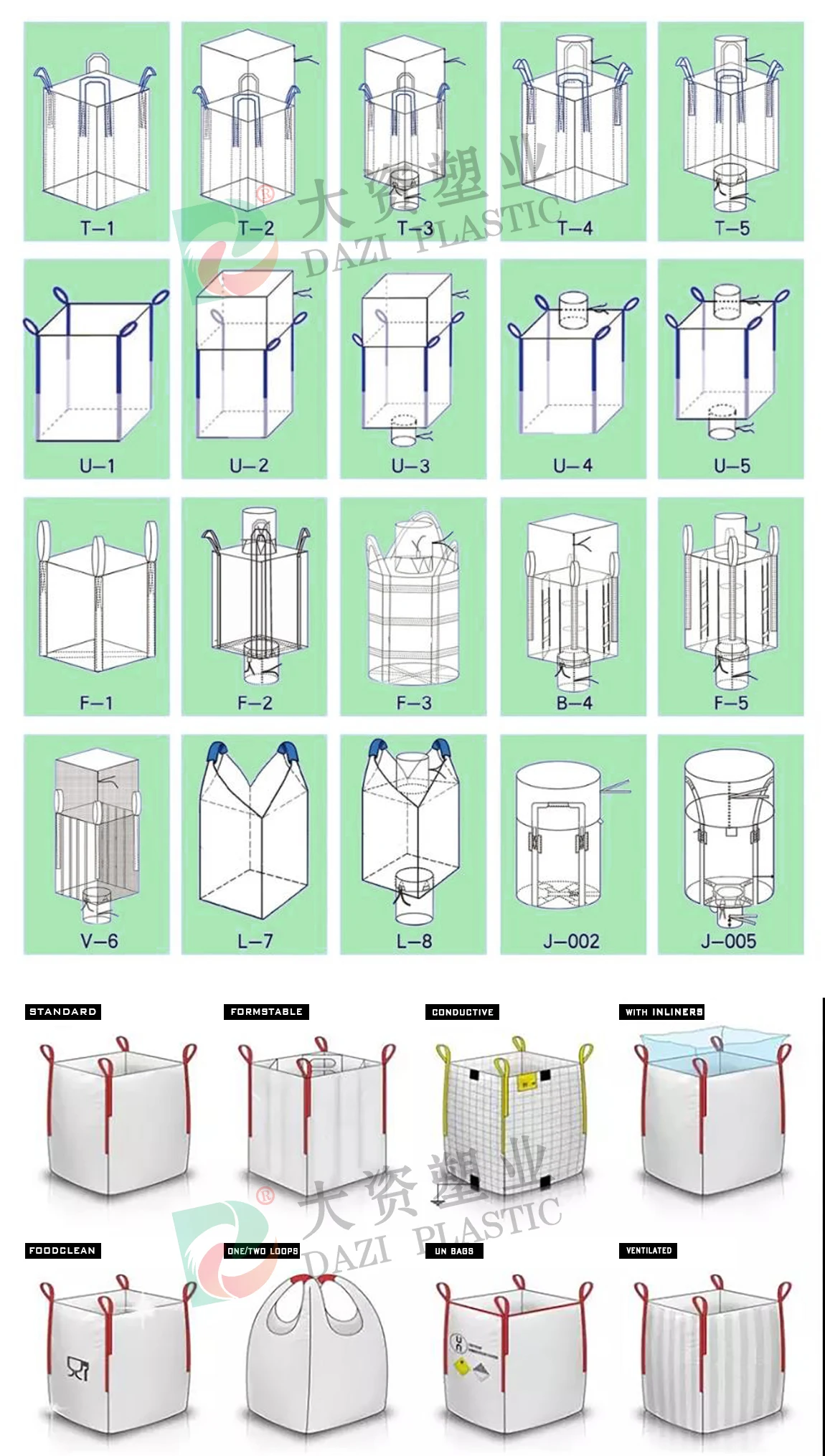
Replace universal single-specification FIBCs with scenario-targeted packaging solutions. For abrasive granular materials, adopt inner anti-wear lining and local bottom double-layer reinforcement structure to resist particle scouring and friction. For corrosive and hygroscopic chemical materials, deploy coated and chemical-resistant modified FIBCs to prevent molecular corrosion and aging. For flammable powder scenarios, equip certified anti-static FIBCs to avoid static aging and safety risks. Accurate material matching fundamentally eliminates structural damage caused by scenario mismatch.
3. Environmental Protection Measures for Outdoor and Long-Term Storage
For outdoor temporary stacking and cross-border sea freight FIBCs, cover waterproof and UV-proof tarpaulins to avoid direct sunlight and rain soaking. Adopt elevated pallet placement to isolate ground moisture and prevent bottom fabric damp aging. For high-temperature and high-humidity workshop environments, choose UV-stabilized and aging-resistant upgraded FIBC grades to extend service life and maintain stable structural strength in harsh environments.
4. Scientific Stacking Rules to Eliminate Fatigue Deformation
Set maximum stacking height limits according to FIBC safety factor and load parameters. Avoid long-term ultra-high compression stacking for reusable circulating bags. Adopt neat symmetrical stacking to ensure uniform vertical force and prevent lateral shear stress. Regularly adjust and turn over long-stacked FIBCs to release internal structural fatigue and avoid permanent deformation and local stress concentration.
5. Pre-Use Inspection and Regular Elimination Mechanism
Establish standardized pre-use inspection procedures to check fabric scratches, stitching looseness, lifting loop damage and surface aging marks. Eliminate potentially defective FIBCs in advance to avoid on-site failure. For reusable FIBCs, implement regular strength testing and batch screening, phase out fatigued bags, and prevent secondary use of aging and damaged packaging carriers.
Economic Value of Standardized FIBC Risk Prevention
Many enterprises ignore FIBC risk management due to low single-bag price, resulting in cumulative hidden losses including material leakage waste, emergency replacement costs, shipment delay losses and workplace safety risks. Systematic risk prevention does not rely on high-cost investment, but on standardized operation, accurate matching and refined management. Effective FIBC protection can significantly reduce bag failure rate, improve material utilization rate, stabilize logistics efficiency and reduce comprehensive operational costs, bringing long-term stable economic benefits for bulk material manufacturing and logistics enterprises.
Conclusion
Most FIBC damage and safety risks are preventable controllable losses caused by irregular operation, scenario mismatch and poor storage management, rather than unavoidable quality problems. Overloading, mechanical scratching, environmental aging and unscientific stacking are the four core damaging causes in industrial scenarios. By implementing standardized handling operations, scenario-based customized configuration, environmental isolation protection and regular inspection screening, enterprises can build a complete FIBC risk prevention system, effectively avoiding structural failure, material loss and safety hazards, and realizing safer, more stable and cost-effective bulk material logistics operation.