
When evaluating bulk handling efficiency, most plant managers focus on FIBC lifting configurations, discharge gates and forklift workflows, while overlooking how the inner liner shapes the whole material transfer cycle. A generic off-the-shelf liner is often treated merely as a dust or moisture barrier, yet it frequently creates unseen disruptions: film bunching at the fill opening, powder adhesion to static-charged liner surfaces, uneven collapse during discharge, and trapped residues that cut into profit margins. Custom liner FIBC bulk bags solve these pain points by tailoring liner geometry, sealing structure and film functionality around your specific bulk material and site equipment, streamlining every step from filling at the feed station to complete discharge into downstream processing units.
Generic tubular liners are cut to a simple rectangular tube size and dropped loosely inside FIBCs, with no fixed positioning or flow-oriented shaping. During filling, incoming material pushes the soft film randomly. For fluffy, low-bulk-density powders such as fillers and carbonates, trapped air cannot escape smoothly, forming air pockets that slow feed rates. Operators often have to pause filling, shake the bag or manually rearrange the liner to release trapped air, breaking continuous weighing and batching sequences.
When it comes to unloading, the drawbacks become even more obvious. As material drains out, loose liners fold inward randomly. These folded film sections form physical barriers. For cohesive, slightly sticky powders, material builds up behind the folds and creates stable arches that will not collapse under gravity alone. Operators have to tap the bag body repeatedly or use vibrators, which extends unloading time and raises the risk of tearing the liner. Even after the bulk of material flows out, fine particles stick to folded creases of the liner, resulting in consistent residual loss per bag.
Another common issue is poor sealing matching. Ordinary liners cannot form a tight connection with filling chutes or receiving hopper inlets. Tiny gaps between the liner sleeve and equipment joints release fine dust, requiring extra dust extraction work and raising workplace safety risks for combustible powder applications.
Custom liner development starts with analyzing flow properties of your bulk product rather than only matching the inner dimension of the outer FIBC. One widely practical customization is the tapered liner profile. Unlike straight tube liners, tapered liners narrow gradually toward the bottom discharge outlet. This design guides particles toward the spout naturally with gravity, reducing dead zones where powder accumulates. It works perfectly for both free-flowing granules and moderately cohesive powders.
Custom split liners and pleated liners are another valuable option for high-speed filling lines. Pre-pleated liners expand evenly as material fills the bag instead of bulging unevenly to one side. Controlled expansion keeps the fill collar open and aligned with the feeding nozzle all the time, eliminating manual adjustment. This feature is especially suitable for automated filling stations that run dozens of bags per hour.
For sites requiring intermittent unloading, such as formula mixing workshops that take partial material from one bag over multiple shifts, custom liners with integrated tie sleeves bring great flexibility. The extended liner sleeve at the discharge end can be securely tied off after partial discharge, sealing the remaining material away from moisture, dust and cross-contamination without removing the FIBC from its frame.
Film selection is a core part of liner customization, and different functional additives directly change how powder interacts with the liner surface.
Slip-modified liner films are formulated with balanced slip additives. They reduce surface friction between particles and the film, minimizing powder sticking and arching during discharge. They are widely adopted for mineral powders, paint pigments and calcium carbonate formulations. Anti-static liner grades are paired with conductive FIBC bodies for flammable dust; they prevent static buildup on the film surface, stopping fine powder from clinging electrostatically and lowering explosion hazards during loading and unloading.
Barrier liners with moisture-resistant structures are designed for hygroscopic raw materials like certain chemical additives. By blocking ambient humidity, they keep powder free-flowing during storage. If moisture absorption occurs and powder cakes inside the bag, even well-designed discharge spouts will face blockages. Food-contact grade liners use low-extractable resin and additives, meeting global food safety standards while maintaining a smooth surface for clean, residue-limited unloading for grain, food additives and feed materials.
It is worth noting that thicker film is not always better. Over-stiff heavy liners cannot collapse neatly as material drains, leaving more residues. Professional customization balances puncture resistance, flexibility and surface function according to particle sharpness, material weight and discharge method.
A well-customized liner only delivers full advantages when it is coordinated with your existing handling hardware.
If your facility uses fixed docking filling nozzles, the liner’s top cuff diameter and sleeve length should be customized to fit the nozzle outer diameter. A properly sized sleeve can be clamped tightly onto the chute, forming a fully enclosed transfer channel with zero exposed gaps. For discharge stations equipped with bag massage frames or vibratory bases, the liner needs enough flex fatigue resistance to stand repeated shaking without pinhole rupture.
For multi-trip reusable FIBC programs, replaceable custom liners are a cost-effective solution. The liner can be installed and removed independently, protecting the outer woven bulk bag from product contamination. After unloading, the used liner is discarded while the outer FIBC is cleaned and reused, cutting long-term packaging expenditure. For single-trip export shipments, lightweight but high-integrity custom liners help reduce tare weight without sacrificing sealing and flow performance.
Even the best custom liner design can underperform with improper operation. Before starting filling, check that the liner sleeve is not twisted or inverted at the nozzle connection point. A twisted liner immediately restricts material flow and builds internal pressure. Do not overfill the FIBC beyond its rated safe working volume; excessive weight will permanently deform and crease the liner.
During unloading, hoist the bag fully above the receiving hopper before releasing the liner closure, which avoids sudden material surge that overwhelms downstream conveyors. After completing discharge, inspect liner seams, weld points and sleeve connections for pinholes and tears. Damaged liners should be replaced before reuse to prevent unexpected leakage in the next cycle. Store empty lined bulk bags in dry, clean areas and keep them away from sharp metal fragments that can puncture the liner film before use.
Custom liner FIBC bulk bags upgrade bulk logistics by treating the inner liner as an active component of the material flow system, rather than a simple protective add-on. Optimized liner shaping, surface functional treatment and equipment-matched sleeve design eliminate liner-caused bottlenecks: stable and dust-tight loading, smoother gravity discharge, fewer blockages from bridging and less valuable product trapped as residue. For bulk processors aiming to raise line throughput, cut labor input and reduce material waste, properly customized liners bring measurable and sustainable improvements to every loading and unloading cycle.
|
Description
|
FIBC/Jumbo bag/bulk bag/ pp big bag/Flexible container bag professional manufacturer
|
|
Type of bag
|
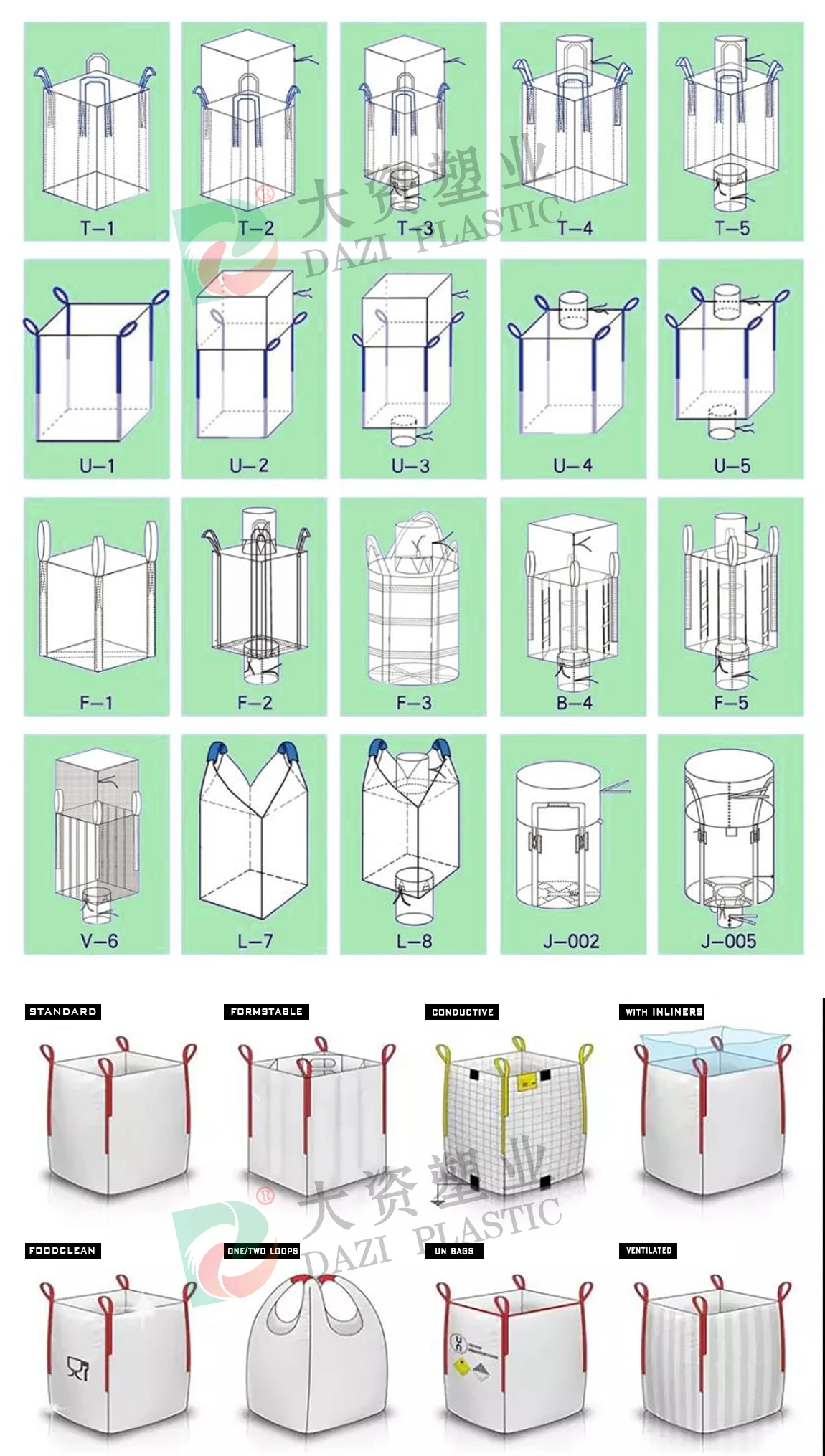
Tubular/Circular/U-panel shape//Rectangular
|
|
Material
|
100% Virgin PP
|
|
Fabric
|
Laminated/Plain/Vent/Conductive
|
|
Size
|
Customized
|
|
GSM
|
110gsm-230gsm
|
|
Color
|
Customized
|
|
Printing
|
Customized
|
|
Top
|
Full open/Filling spout/Top skirt/Duffle
|
|
Bottom
|
Flat/plain/with discharge spout
|
|
Liner
|
Liner(HDPE, LDPE) or Customized
|
|
Lifting loop
|
Cross-corner loops/4 Point 2 Strap lifting loop/Double Stevedore Strap/with belt/Fully belt loop/Loop in loop
|
|
Sewing
|
Plain/chain/chain lock with optional soft-proof
|
|
Ropes
|
1 or 2 around the bag body/customized
|
|
SWL
|
500-2000KG
|
|
SF
|
5:1/6:1/or as customer's requirement
|
|
Treatment
|
UV treated or not UV treated
|
|
Surface Dealing
|
Coated or plain,printing or no printing
|
|
Usage
|
Storage and packing
Mine,ore,fertilizer,chemical,onion,potato,grain,wheat,maize,rice,peanut,sugar,salt,agriculture,building material,powder,cement,etc. |
|
Processing
|
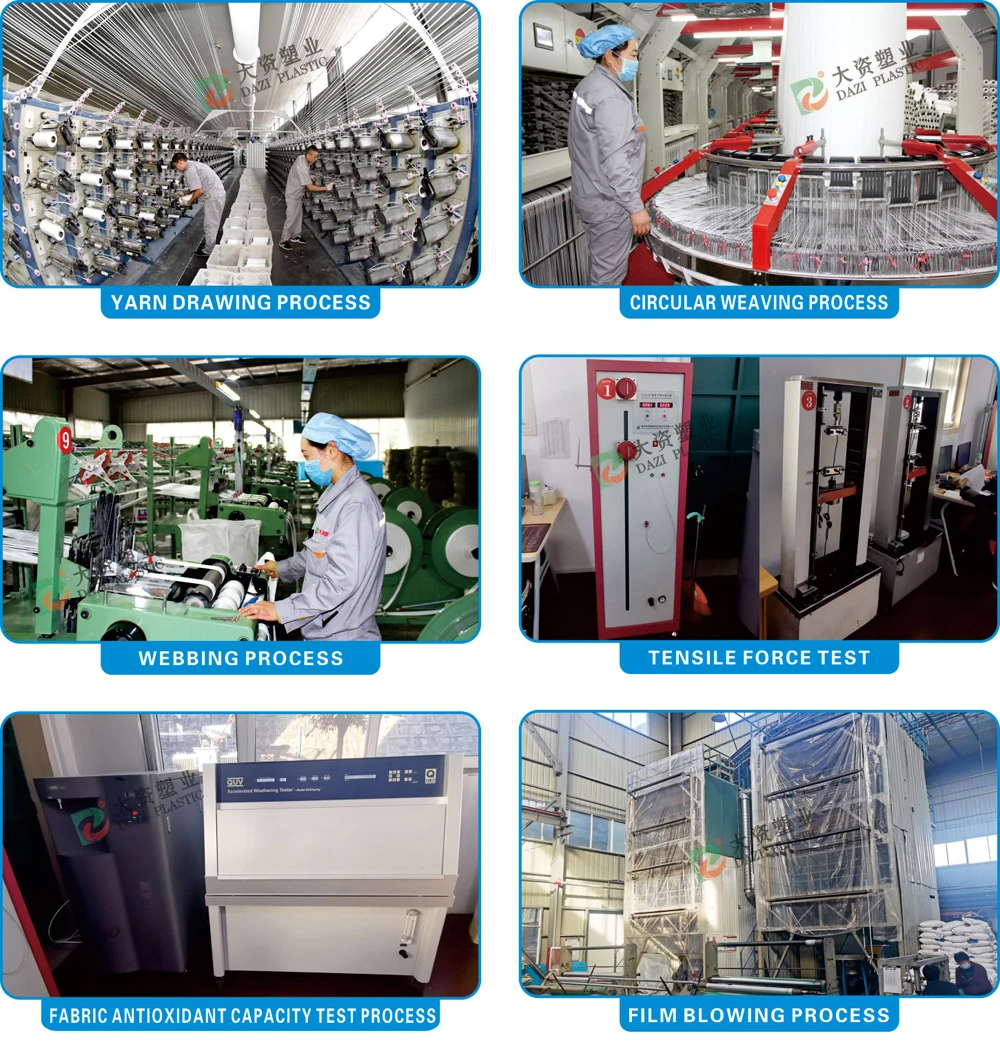
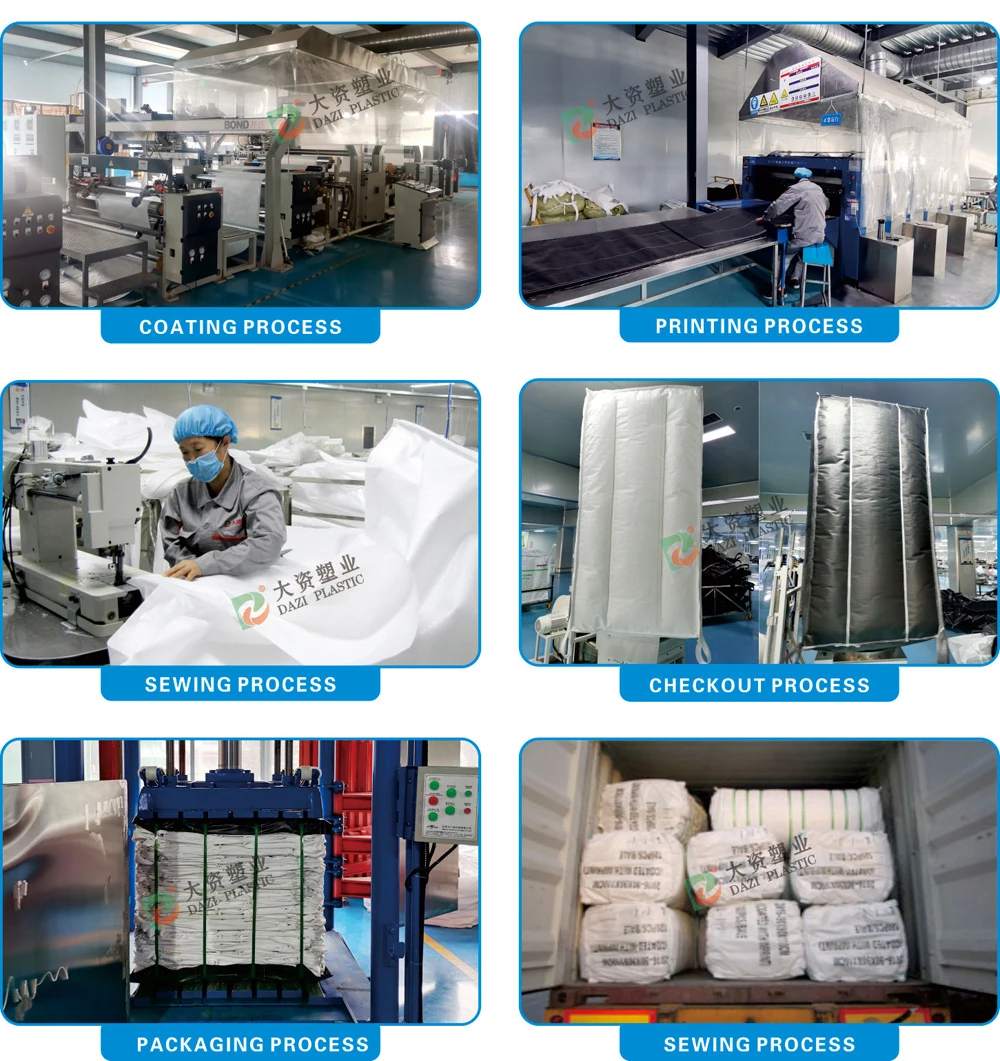
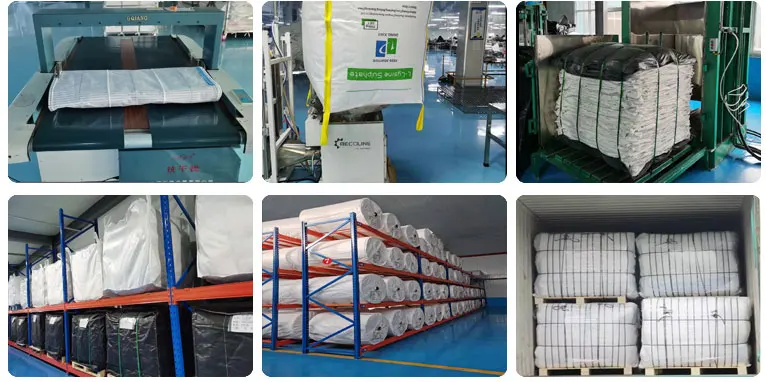
Yarn drawing-Circular weaving/Webbing-Quality inspection-Coating-Film
blowing-Cutting-Printing-Sewing-Checkout-Packaging-Transportation |
|
Delivery time
|
15-30 days
|
|
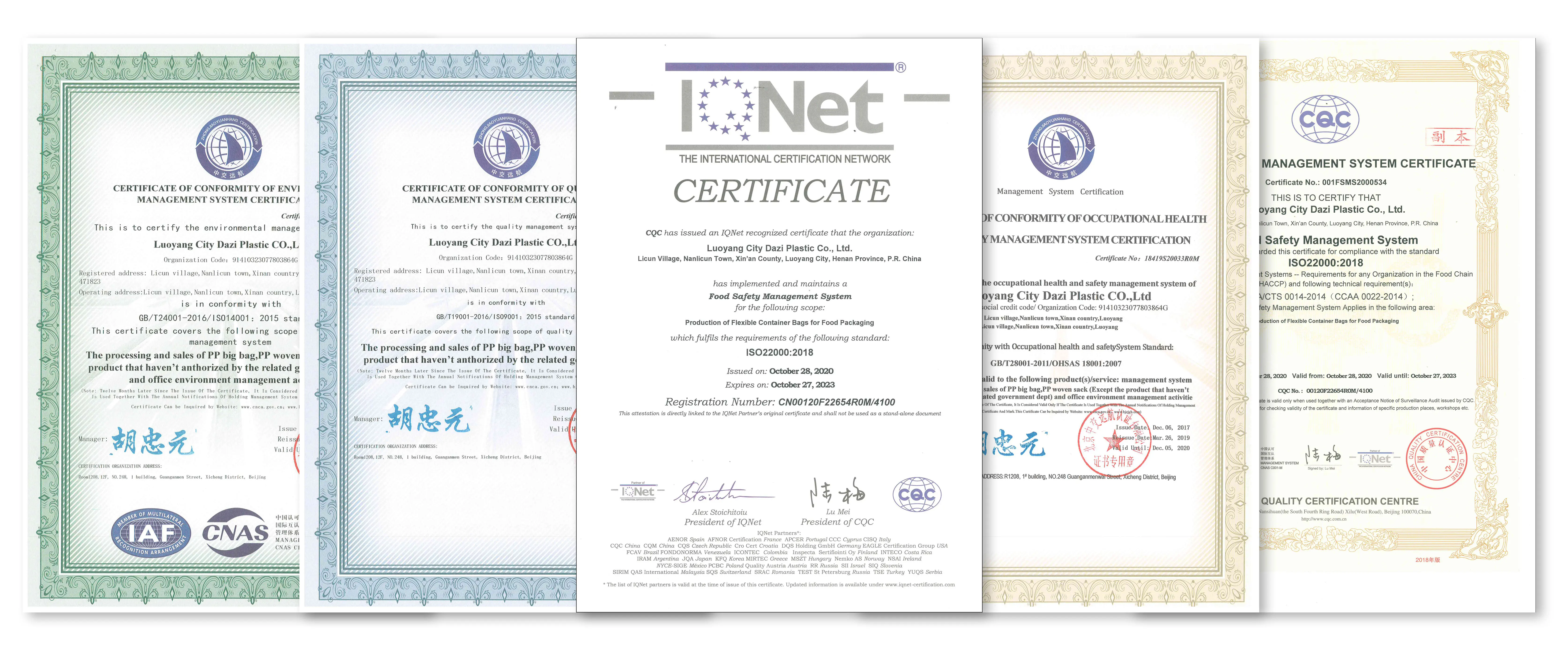
Certification
|
ISO22000, ISO9001, ISO14001, LABORDATA, etc.
|
|
Remark
|
Please let us know your specific requirements
|






Авторск прав © лоя больш работ полиэтил индастрис