Granular raw materials including industrial mineral particles, chemical granules, fertilizer pellets, plastic granular materials and building aggregates are commonly stockpiled in open yards, port terminals and outdoor factory storage areas for weeks or even months. Unlike short-term transit packaging, long-term outdoor FIBC storage faces continuous environmental erosion such as ultraviolet radiation, day-night temperature alternation, rain infiltration, dust deposition and long-term static stacking pressure. Ordinary standard FIBCs are only designed for temporary turnover and prone to fabric aging, particle caking, bottom bulging, seam loosening and material deterioration after prolonged outdoor placement. Professional outdoor-grade FIBCs require targeted structural, material and functional design optimizations to adapt to granular material storage characteristics and harsh open-air environments. This article systematically introduces the core design points of FIBC bulk bags specialized for long-term outdoor storage of granular raw materials.
Special Environmental and Material Challenges for Outdoor Granular Storage
Granular materials have unique physical characteristics different from fine powder: good fluidity, strong gravity accumulation, uniform particle gaps and certain anti-compression performance. However, long-term outdoor storage brings coupled aging risks. Continuous solar UV rays degrade PP woven fiber toughness; seasonal rain and dew penetrate bag gaps to cause granular moisture absorption and caking; long-term static gravity stacking leads to permanent bag deformation and local stress concentration; alternating cold and hot temperatures accelerate material fatigue and stitching aging. Without targeted outdoor-oriented design, conventional FIBCs will suffer from shortened service life, material quality decline and even sudden bag rupture and material scattering losses.
1. UV-Stabilized Outdoor-Grade Fabric Material Design
Anti-ultraviolet aging is the most fundamental design index for long-term outdoor storage FIBCs. Ordinary PP woven fabrics lack anti-UV components, and their molecular chains will break after 2–3 months of outdoor sunlight exposure, resulting in fabric brittleness, fading, sharp tensile strength drop and easy tearing. Professional outdoor FIBCs adopt permanent UV-stabilized PP raw materials with evenly blended anti-aging masterbatch during weaving, rather than superficial surface coating which fails easily after friction and washing.
This integral UV protection design effectively resists ultraviolet oxidation and high-temperature aging, maintaining stable tensile strength and fabric toughness for 6–12 months of open-air storage. It avoids the common failure of standard bags that become brittle and cracked after short-term outdoor placement, ensuring structural integrity throughout the long storage cycle for granular raw materials.
2. Breathable & Waterproof Balanced Sealing Structure Design
Granular raw materials are prone to internal condensation and surface damp caking in outdoor humid environments. Fully sealed non-breathable FIBCs trap internal moisture caused by day and night temperature difference, while overly loose woven structures lead to rain penetration and dust pollution. Therefore, outdoor storage FIBCs must adopt a balanced breathable and waterproof design exclusive for granular materials.
The optimized dense woven structure blocks external rainwater and floating dust infiltration, while retaining tiny breathable gaps to discharge internal condensed vapor. For hygroscopic chemical granules and fertilizer particles, matched breathable PE inner liners are added to further isolate external humidity without causing internal stuffy dampness. This unique design effectively solves the core pain points of granular material caking, mildew and quality degradation during long-term outdoor storage.
3. Reinforced Bottom Structure and Anti-Slip Base Design
Granular materials have high fluidity and concentrated gravity, bringing continuous and uniform bottom pressure to FIBCs during long-term static stacking. Ordinary flat-bottom FIBCs are prone to bottom bulging, edge warping and uneven stress after long-term placement, and are easy to slide and collapse in outdoor windy environments.
Professional outdoor storage FIBCs adopt X-type reinforced base stitching and thickened wear-resistant bottom fabric. The integrated reinforced bottom disperses long-term gravity pressure of granular materials, effectively preventing permanent deformation and local wear fatigue. Meanwhile, customized anti-slip texture base increases friction with the ground and pallet surface, avoiding bag sliding and stacking collapse caused by outdoor wind and ground inclination, greatly improving the overall stability of outdoor stockpiles.
4. Cubic Shaping Design for Stable Long-Term Stacking
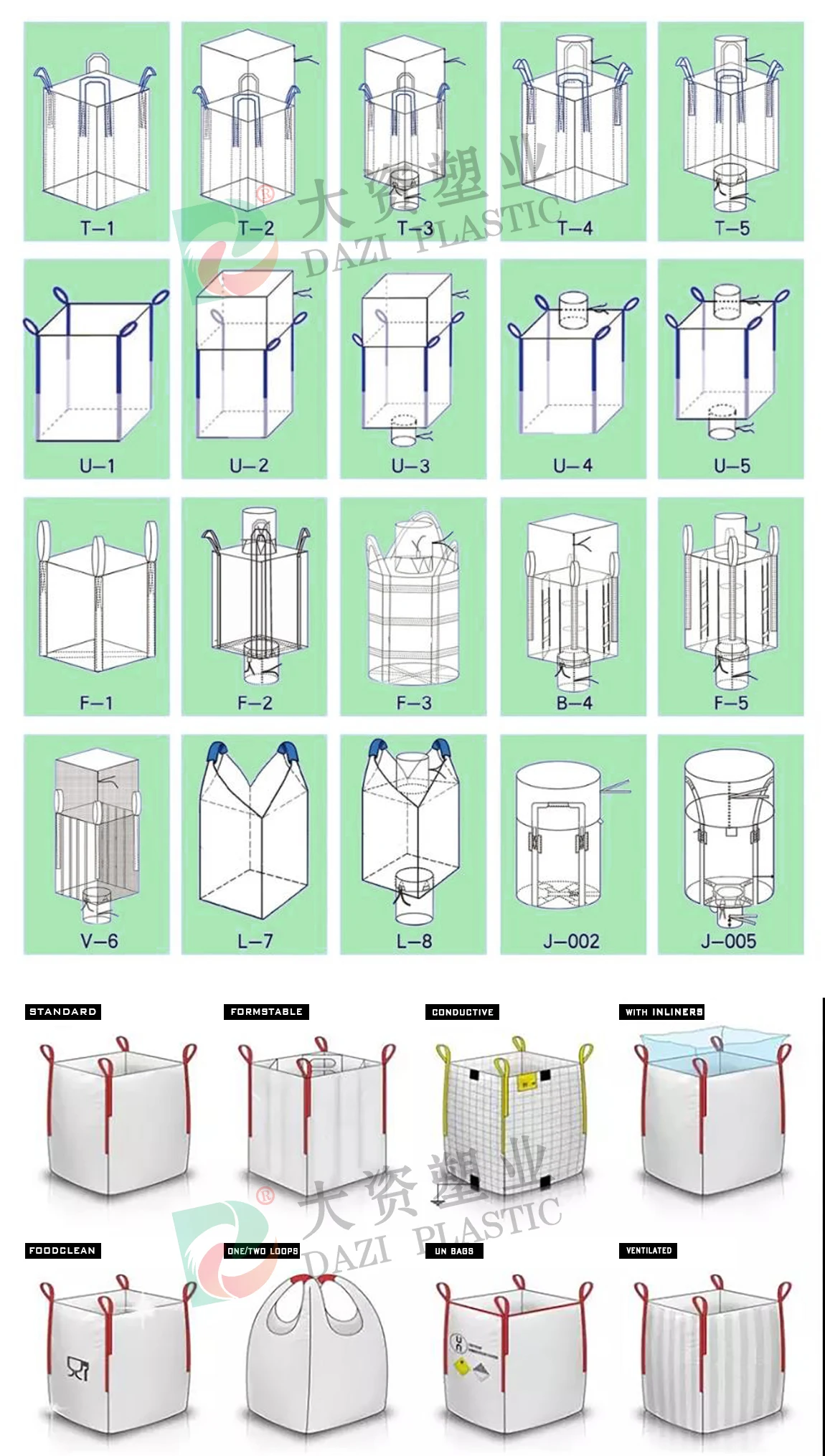
Unstructured circular FIBCs filled with granular materials are prone to irregular bulging, resulting in unstable stacking, easy rolling and large gap waste in outdoor storage yards. For long-term outdoor centralized stockpiling, FIBCs adopt U-panel cubic shaping design to standardize the overall bag shape after filling.
The cubic shaping structure limits irregular expansion of fluid granular materials, ensuring neat and square single-bag shape. It supports multi-layer stable vertical stacking without tilting or deformation, maximizes outdoor yard space utilization, and avoids safety hazards of high stacked bag collapse after long-term wind and rain erosion. This structural design turns scattered granular material packaging into standardized storable units, realizing orderly long-term outdoor management.
5. High-Fatigue Stitching and Reinforced Lifting Loop Design
Long-term outdoor storage is often accompanied by multiple seasonal turnover, stacking height adjustment and batch transfer. Ordinary FIBC stitching and loop connection points suffer from invisible fatigue damage after long-term static pressure and repeated lifting, easily causing thread loosening and loop detachment.
Outdoor special FIBCs adopt multi-layer overlapping stitching, high-tension anti-aging thread and integral loop reinforcement technology. The connection part of lifting loops and the bag body is reinforced with thickened gaskets to disperse stress, resisting long-term static pressure fatigue and repeated mechanical handling tension. Even after several months of outdoor static storage and subsequent secondary transportation, the stitching and loops still maintain original tensile strength, avoiding breakage accidents during post-storage turnover.
6. Scientific Safety Factor Matching for Static Storage Fatigue
Most users only pay attention to the dynamic transportation safety factor but ignore the static pressure fatigue risk of long-term storage. Standard 5:1 safety factor FIBCs are only suitable for short-term turnover; after long-term high stacking static pressure, they will have structural fatigue and strength attenuation.
FIBCs for long-term outdoor granular storage uniformly adopt 6:1 industrial high safety factor. The excess safety margin resists structural strength attenuation caused by long-term static load, temperature alternation and UV aging. It ensures that the bag body does not deform, crack or fail during the whole storage cycle, realizing long-term safe and stable storage of granular raw materials.
7. Dust-Proof and Anti-Pollution Functional Design
Outdoor open storage faces floating dust, fallen leaves, bird droppings and industrial flue gas pollution, which easily adhere to granular material surfaces and affect raw material purity. Professional outdoor FIBCs adopt encrypted woven outer layer and sealed top cover design. The fully covered top structure effectively blocks external sundries and pollutants, keeping granular materials clean without affecting ventilation and moisture dissipation.
Scenario-Based Design Matching for Different Granular Materials
-
Inert mineral granules: UV-stabilized fabric + anti-slip bottom + cubic shaping design, focusing on outdoor anti-aging and stacking stability
-
Hygroscopic chemical and fertilizer granules: Breathable waterproof structure + inner liner sealing design to prevent damp caking
-
Large-particle abrasive granular materials: Thickened wear-resistant fabric + enhanced bottom stitching to avoid particle friction damage
-
High-purity industrial granular raw materials: Full dust-proof sealing + pollution-free raw material design to ensure material purity
Common Design Defects of Ordinary Outdoor FIBCs
Many unqualified outdoor FIBCs simplify core design structures, resulting in poor long-term storage performance. Common defects include non-UV-treated ordinary fabric leading to rapid aging, single-layer thin bottom causing bulging deformation, unshaped circular structure leading to unstable stacking, non-breathable fully sealed design causing internal condensation caking, and insufficient stitching reinforcement leading to fatigue failure. These simplified designs reduce single-bag cost but cause huge hidden losses such as material deterioration, bag replacement and safety accidents in long-term outdoor storage.
Conclusion
The core design logic of FIBC bulk bags for long‑term outdoor storage of granular raw materials is to adapt to dual environmental tests: long-term natural weathering and continuous static gravity load. Through UV anti-aging material optimization, breathable and waterproof balanced structure, reinforced anti-deformation bottom design, cubic shaping stacking structure and high-fatigue stitching reinforcement, professional outdoor FIBCs perfectly solve the pain points of granular material caking, pollution, bag deformation and aging failure. Adopting FIBCs with targeted outdoor storage design is the key to ensure raw material quality stability, improve yard storage efficiency and reduce long-term packaging and material loss costs for industrial enterprises.