Hazardous powder transportation is one of the most strictly regulated links in industrial bulk logistics, covering flammable fine chemicals, combustible metal dust, reactive pharmaceutical powders and explosion-prone mineral particles. Unlike inert granular materials, hazardous powders generate continuous electrostatic friction during pneumatic filling, road vibration and container transit. Accumulated static charges can trigger dust deflagration, personnel electric shock and onsite combustion accidents. Many logistics and procurement teams make blind anti-static FIBC selections based only on basic anti-static labels, ignoring material ignition characteristics, explosion zone classification and operational grounding conditions, resulting in non-compliant packaging, hidden safety hazards and customs clearance failures. This article delivers a fully practical, standard-compliant selection framework for anti-static FIBCs, helping manufacturers match the safest and most cost-effective bulk bag solutions for hazardous powder shipping.
Understand Core Hazard Indicators That Determine FIBC Selection
The first step in selecting qualified anti-static FIBCs is judging powder hazard levels via two core industrial indicators: Minimum Ignition Energy (MIE) and dust explosion atmosphere classification. These two parameters directly define which anti-static grade is eligible and eliminate over-spec or under-spec packaging errors.
Hazardous powders with ultra-low MIE (below 10mJ) belong to high-risk explosive materials, including aluminum powder, carbon black, fine organic chemical dust and lithium battery raw material powder. Such materials can be ignited by tiny static sparks, requiring high-grade conductive or static-dissipative FIBCs. Powders with medium MIE values can still form explosive dust clouds in confined container spaces, making ordinary anti-static bags completely ineffective. Meanwhile, working environments classified as Zone 1 and Zone 2 explosive dust atmospheres require strictly certified anti-static FIBCs to meet ATEX and IEC 61340-4-4 international safety standards.
Distinguish Four Official FIBC Static Grades & Exact Applicable Scenarios
Most procurement errors stem from confusing the four standardized FIBC electrostatic types. Each grade has clear functional boundaries and hazardous powder adaptation ranges, with no universal anti-static alternative.
Type A FIBC (Non-anti-static)
Made of pure insulating polypropylene fabric with no static protection function. It is only suitable for completely inert non-flammable materials and non-explosive environments. Strictly prohibited for all hazardous powder transportation, as it will continuously accumulate static charges with zero discharge channels.
Type B FIBC (Basic Anti-static)
Type B bags limit maximum surface voltage to avoid high-potential static sparks, but cannot actively dissipate static electricity. They can prevent propagating brush discharges and apply only to low-risk powders with MIE above 25mJ, without flammable vapor mixing in the environment. They are not qualified for ultra-fine explosive powders and closed-container long-distance transportation.
Type C Conductive FIBC (Grounding-Dependent Explosion-proof)
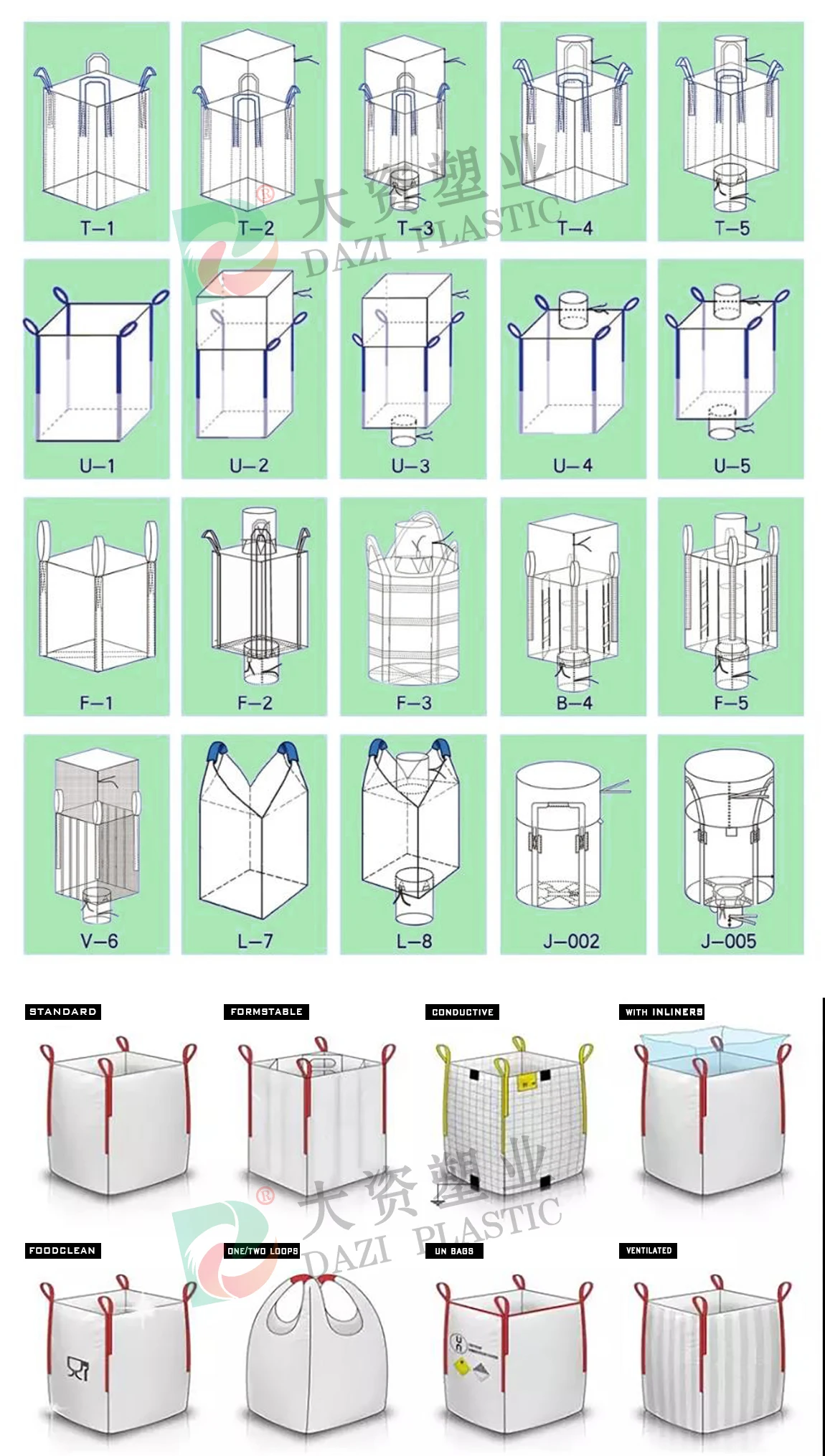
Featured with integrated continuous conductive grid yarns and dedicated grounding lugs, Type C FIBCs form a complete static derivation loop. All frictional static charges generated by hazardous powders are safely guided to the ground, thoroughly eliminating charge accumulation. It is the mandatory packaging for high-risk explosive powders with MIE less than 10mJ and fully compliant for Zone 1/Zone 2 hazardous areas. It delivers stable explosion-proof performance and high cost performance for fixed workshop filling and factory-grounded logistics operations.
Type D Static-Dissipative FIBC (Ground-Free Anti-static)
Adopting advanced self-dissipative static fabric, Type D FIBCs neutralize static energy through low-energy corona discharge without any grounding connection. This design completely avoids human operational errors such as missed grounding, which is the biggest safety advantage over Type C bags. It is ideal for ungrounded outdoor stacking, cross-border container transportation and mobile field handling of hazardous powders, and adapts to complex variable logistics environments where grounding facilities are unavailable.
Step-by-step Practical Selection Workflow for Hazardous Powders
1. Confirm Powder MIE Value and Explosion Risk Level
Check material safety data sheets (MSDS) to confirm powder MIE, dust explosion limit and whether flammable vapor coexists. For ultra-low MIE explosive powders, directly select Type C or Type D certified products; for low-risk hazardous powders with high MIE, qualified Type B anti-static FIBCs can control costs reasonably.
2. Match Anti-static Type Based on On-site Grounding Conditions
If the factory filling station and loading area are equipped with standard grounding systems, Type C FIBCs are the most cost-effective choice with stable and reliable static elimination. If the logistics link involves frequent outdoor turnover, container transportation and ungrounded temporary storage, Type D ground-free FIBCs must be adopted to avoid safety dead zones caused by unavailable grounding.
3. Verify Structural Adaptability for Fine Hazardous Powders
Most hazardous powders are ultra-fine and prone to micro-leakage and static adhesion. During selection, prioritize encrypted weaving anti-static FIBCs with dust-proof inner liners and fully sealed spout structures to prevent fine powder leakage and secondary floating dust hazards. Avoid standard loose-weave anti-static bags that cause dust diffusion and environmental risks.
4. Check Safety Factor and Mechanical Reinforcement
Hazardous powder logistics requires higher structural safety redundancy. Select FIBCs with 6:1 industrial safety factor and reinforced lifting loops and corner stitching. Long-distance transportation and multi-layer stacking will generate continuous lateral pressure and vibration impact; reinforced structure effectively prevents bag tearing and material leakage, avoiding secondary safety accidents caused by packaging failure.
5. Audit Complete Compliance Certifications
Qualified anti-static FIBCs for hazardous powder transport must provide complete third-party test reports, including IEC 61340-4-4 electrostatic performance test, ATEX explosion-proof certification and UN hazardous goods packaging qualification. Complete certifications ensure smooth factory safety audits and export customs clearance, eliminating compliance risks.
Common Selection Mistakes to Avoid
The most prevalent mistake is equating ordinary surface-coated anti-static bags with professional Type C/D explosion-proof FIBCs. Coating-type anti-static treatment wears off quickly after friction and rain washing, with completely failed static protection in long-distance transportation. Another typical error is ignoring environmental factors: using Type C bags without reliable grounding leads to zero anti-static effect and extreme explosion risks. In addition, over-specification selection for low-risk materials causes unnecessary cost waste, while under-specification matching for high-risk powders brings fatal safety hazards.
Cost-Effective Matching Strategy
Scientific anti-static FIBC selection balances safety compliance and procurement cost. For fixed indoor production and short-distance turnover of high-risk powders, Type C grounded conductive FIBCs achieve optimal safety and cost balance. For cross-border export, outdoor storage and mobile logistics scenarios, Type D ground-free FIBCs eliminate operational errors and safety blind spots. For batch stable low-risk hazardous powder transportation, standardized Type B anti-static FIBCs can meet compliance requirements and control packaging costs effectively.
Conclusion
Selecting the correct anti-static FIBC for hazardous powder transportation relies on standardized grade matching based on powder MIE characteristics, explosion zone classification and actual logistics environment, rather than subjective experience or single price comparison. Distinguishing Type A/B/C/D functional differences, matching grounded or ground-free structures reasonably, and verifying mechanical performance and compliance certifications can completely eliminate static explosion risks, powder leakage hazards and non-compliant logistics issues. A targeted anti-static FIBC selection system helps hazardous material enterprises achieve safe, compliant and cost-controlled bulk powder transportation management.