Flammable powder material handling and transportation rank among the highest-risk operational links in fine chemical, new energy, pharmaceutical and advanced plastic manufacturing industries. Ultra-fine combustible powders such as organic chemical dust, lithium battery raw materials, toner powder and resin fine particles feature extremely low minimum ignition energy (MIE). During pneumatic filling, gravity discharging, vehicle vibration and stacking turnover, continuous friction between powder particles and packaging inner walls rapidly accumulates static electricity. Ordinary PP woven FIBCs are inherently insulating, trapping static charges on the fabric surface and easily triggering electrostatic sparks, dust deflagration or explosion accidents. Conductive FIBC bulk bags adopt professional static-conductive and static-dissipative weaving structures, providing targeted electrostatic safety barriers for flammable powder storage and transportation. As the only compliant packaging solution for combustible bulk powder scenarios, it eliminates static explosion risks while standardizing industrial hazardous material logistics.
Why Flammable Powder Transport Requires Exclusive Conductive FIBCs
Ordinary anti-static and standard FIBCs cannot adapt to flammable powder working conditions due to fundamental structural limitations. Common low-grade anti-static bags rely on surface coating treatment, which features unstable efficacy, easy friction failure and limited charge dissipation capacity, unable to cope with continuous static accumulation during large-volume powder turnover. Standard insulating FIBCs completely block static release, forming high-potential charge concentration on the bag surface once powder friction occurs.
Flammable powder scenarios have dual risk characteristics: suspended dust clouds in confined spaces and low ignition energy sensitivity. Even micro-level static sparks below 5mJ can ignite mixed dust-air mixtures, leading to workplace explosions, equipment burnout and personnel safety accidents. In addition, cross-regional transportation and outdoor temporary storage further increase static generation probability due to dry air and mechanical vibration. Conductive FIBCs are professionally engineered to solve these industry pain points, achieving controllable static release and zero-risk charge accumulation throughout the whole process.
Core Technical Classification and Working Principles of Conductive FIBCs
Industrial conductive FIBCs are strictly divided into Type C conductive grounding type and Type D static-dissipative type, with differentiated working mechanisms and applicable scenarios, forming a complete safety system for flammable powder logistics.
Type C Grounded Conductive FIBCs
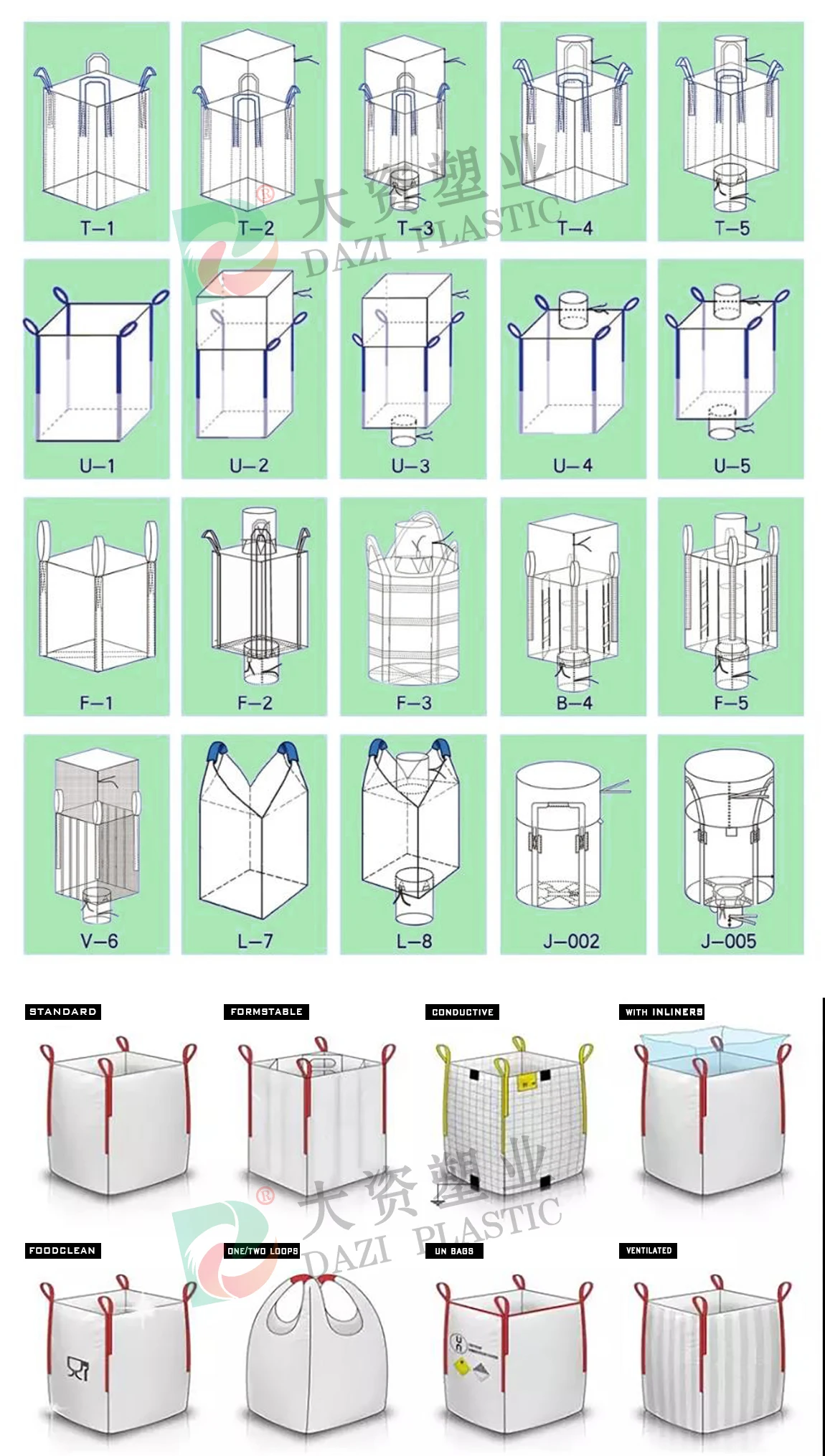
Type C FIBCs are woven with continuous grid-shaped conductive threads inside conventional polypropylene fabric, with reserved grounding lugs at the top and bottom. The entire conductive network forms a complete electrical loop. During material filling, discharging and transportation, all static charges generated by powder friction are concentrated through the conductive yarns and quickly guided to the ground via professional grounding connection. This zero-resistance charge export mechanism completely avoids static accumulation and spark generation. Type C conductive FIBCs are suitable for fixed workshops, indoor production lines and scenarios with complete grounding facilities, supporting long-term stable static protection for high-volume flammable powder processing.
Type D Ground-Free Static-Dissipative FIBCs
Type D represents advanced conductive FIBC technology, adopting proprietary quasi-conductive fabric and carbon-doped yarn weaving structure without relying on grounding devices. The special fabric can ionize surrounding air through corona discharge effect, safely and spontaneously dissipating surface static charges into the atmosphere at ultra-low energy levels. It effectively limits discharge energy below the safe threshold of flammable dust, eliminating explosion risks. Completely free from grounding equipment and operational restrictions, Type D FIBCs perfectly adapt to mobile transportation, outdoor stacking, container loading and ungrounded field operations, covering safety blind spots of Type C conductive bags in complex logistics scenarios.
Unique Safety and Operational Advantages in Flammable Powder Logistics
1. Eliminate Static Explosion and Ignition Risks Fundamentally
Different from passive anti-static protection, conductive FIBCs adopt active charge elimination mechanisms. Type C realizes thorough charge grounding derivation, while Type D achieves intelligent energy-limited dissipation. Both technical routes avoid dangerous static spark discharge, effectively preventing dust cloud ignition and powder combustion accidents. For high-risk flammable powders with MIE lower than 10mJ, conductive FIBCs provide mandatory safety protection that ordinary packaging cannot replace, ensuring compliance with industrial explosion-proof grading standards.
2. Avoid Operational Safety Accidents Caused by Static Electricity
Static accumulation not only triggers explosion risks but also causes frequent electric shocks for operators. Frequent static stings easily lead to misoperation and panic during manual bag handling, indirectly inducing falling, collision and material leakage accidents. Conductive FIBCs maintain the bag surface in a continuous electrically neutral state, completely eliminating static electric shock phenomena, standardizing on-site operational behaviors and improving the overall safety management level of flammable powder workshops.
3. Solve Powder Adsorption and Residue Problems
Static adsorption causes a large amount of flammable fine powder to adhere to the inner wall of ordinary bags, resulting in incomplete discharging and residual material accumulation. Residual combustible powder not only causes material waste but also forms secondary hidden danger of dust floating and combustion. Conductive FIBCs stabilize surface potential, weaken powder electrostatic adsorption, realize thorough discharging of flammable powders, reduce residual dust accumulation, and eliminate secondary safety hazards and material loss.
4. Adapt to Complex and Variable Logistics Environments
Flammable powder transportation involves multiple variable environments such as dry seasons, high-altitude areas, long-distance road transportation and sealed container shipping, all of which accelerate static generation. Conductive FIBCs feature stable temperature and humidity resistance, with durable conductive performance that does not fail due to dry air, temperature changes or long-term vibration. They maintain continuous and effective static protection in the whole supply chain from factory filling, warehousing and stacking to cross-regional transportation.
Compliance Value for Industrial Safety Audits and Hazardous Goods Transportation
Global occupational safety and hazardous goods transportation regulations clearly stipulate that flammable powder materials must use certified conductive static-proof packaging. Ordinary insulating FIBCs and non-certified anti-static bags cannot pass factory safety audits, customer ESG inspections and dangerous goods customs clearance, resulting in production suspension rectification and shipment detention. Professional conductive FIBCs complete strict electrostatic performance testing and explosion-proof certification, with traceable safety parameters, helping enterprises meet standardized production requirements and avoid compliance penalties and order losses.
Scientific Scenario Matching of Type C and Type D Conductive FIBCs
To achieve optimal safety and cost performance, enterprises need to select conductive FIBC types based on actual working conditions:
-
Type C Conductive FIBCs: Ideal for fixed indoor production lines, factory internal cyclic turnover and workshops with complete grounding systems. With lower unit cost and stable performance, it is the best choice for long-term standardized flammable powder processing.
-
Type D Static-Dissipative FIBCs: Suitable for outdoor temporary storage, cross-border container transportation, field mobile operations and scenarios without reliable grounding conditions. It eliminates operational errors caused by missed grounding and is the safest solution for complex and mobile logistics links.
Key Usage and Maintenance Tips to Sustain Safety Performance
Although conductive FIBCs have excellent static-proof performance, standardized usage is required to maintain long-term effectiveness. For Type C bags, ensure reliable grounding connection before filling and prohibit operation without grounding. For Type D bags, avoid surface oil pollution, water stain coverage and conductive substance adhesion, which may affect corona discharge efficiency. Regularly check the integrity of conductive threads and grounding lugs, and phase out aging and damaged bags in time to avoid potential safety hazards caused by performance attenuation.
Conclusion
Conductive FIBC bulk bags are irreplaceable safety packaging for flammable powder material storage and transportation. Through two core technical systems of grounded conduction and ground-free static dissipation, they fundamentally solve static explosion risks, powder adsorption residue and operational safety hidden dangers existing in traditional packaging. Reasonable matching of Type C and Type D conductive FIBCs according to working conditions can help flammable powder processing and logistics enterprises realize compliant, safe and efficient supply chain operation, effectively reducing safety accidents and compliance risks, and providing solid guarantees for standardized industrial hazardous material management.