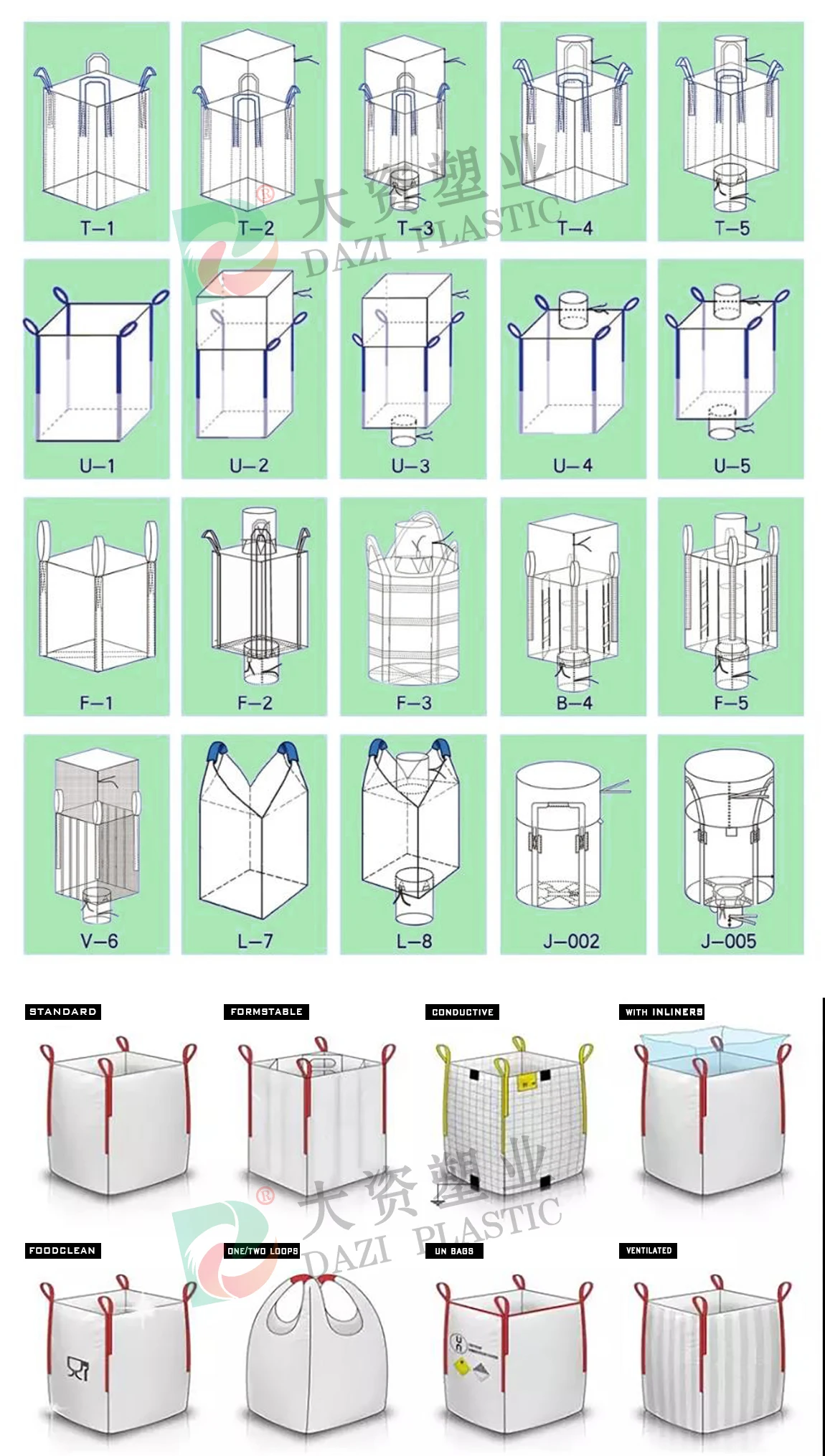
Baffle FIBCs, also widely known as Q-bags or form-stable bulk bags, are a structurally optimized industrial packaging solution specially engineered for free-flowing bulk powders and fine granular materials. Unlike conventional circular or U-panel FIBCs that bulge irregularly after filling, baffle FIBCs adopt unique internal fabric baffle structures to lock a neat cubic shape under full load. For powder-dependent industries including fine chemicals, food additives, pharmaceutical intermediates, plastic powder and mineral fillers, traditional bulk bags always cause long-term operational pain points such as low container loading rate, unstable stacking, powder bridging and severe space waste. As a targeted upgraded packaging design, baffle FIBC fundamentally solves the inherent defects of standard bags, realizing full optimization of bulk powder storage stability, transportation efficiency and comprehensive logistics costs.
Unique Structural Principle of Baffle FIBCs
The core difference that distinguishes baffle FIBCs from ordinary bulk bags lies in its internal restraint system. Standard FIBCs rely solely on external woven fabric to contain materials, and fluid powder will push the sidewalls outward to form irregular spherical bulges during filling, resulting in uneven outlines and loose overall structure. In contrast, baffle FIBCs are sewn with four sets of integrated internal fabric baffles at the four corners of the bag body. These flexible restraint panels connect adjacent sidewalls, effectively limiting lateral expansion and corner bulging when powder materials fill the cavity.
This internal baffle design does not block material flow or affect discharging efficiency. Instead, it evenly disperses the lateral expansion force generated by loose powder, forcing the fully filled bag to maintain precise square and flat-top shaping. The whole bag body presents regular right-angle edges and uniform vertical sidewalls, completely changing the irregular deformation problem of traditional powder packaging. Combined with high-strength flat bottom structure, baffle FIBCs achieve excellent vertical uprightness and overall structural regularity, which is the key to its superior storage and transportation performance.
Core Advantages of Baffle FIBCs for Bulk Powder Handling
1. Maximize Container and Warehouse Space Utilization
Bulk powder logistics has always faced serious space waste caused by irregular bag deformation. Bulged standard FIBCs cannot be closely arranged, leaving a large number of irregular gaps in containers and warehouses, which greatly reduces effective loading capacity. Baffle FIBCs perfectly solve this problem with fixed cubic shaping. Regular square bags can be closely arranged without gaps, increasing container space utilization by 20%–30% compared with ordinary FIBCs. For cross-border container transportation and high-density warehouse storage, this optimization directly reduces unit freight and storage occupancy costs, bringing substantial cumulative cost savings for large-volume powder enterprises.
2. Enhance Stacking Safety and Anti-Shift Stability
Fine powder materials are prone to internal flow and gravity shift during transportation vibration and high stacking, leading to bag tilting, slipping and even overall collapse. Standard bulging FIBCs have uneven top surfaces, making double-layer stacking impossible and bringing huge safety hazards to high-stock warehouse management. Baffle FIBCs maintain a completely flat top after filling, providing a stable horizontal support surface for multi-layer stacking.
The internal baffle structure restricts internal powder displacement, ensuring uniform gravity distribution of each bag. It effectively resists lateral shear force generated by vehicle bumping and wind vibration, avoiding cargo tilt and stacking collapse during long-distance transportation. This stable stacking capability allows safe double-high stacking in standard containers, doubling single-shipment loading volume and greatly improving logistics turnover efficiency.
3. Eliminate Powder Bridging and Residual Waste
Many powder processing enterprises encounter incomplete discharging problems caused by material bridging. Traditional round FIBCs form concave dead corners at the bottom, where fine powder is easily compacted and agglomerated to form bridging structures, resulting in a large amount of residual powder that cannot be discharged. Baffle FIBCs feature smooth and regular inner walls without dead corners, and the structural restraint avoids excessive local compaction of powder materials.
During gravity discharging, powder slides down evenly along vertical sidewalls with unobstructed flow, thoroughly eliminating bridging and residue problems. This improvement significantly increases material utilization rate, especially for high-value chemical powders, pharmaceutical powders and rare mineral powders, effectively reducing material waste and improving enterprise economic benefits.
4. Avoid Container Jamming and Loading Difficulties
Over-bulged standard FIBCs are easily squeezed and deformed during container loading, often causing bag jamming that cannot be placed or unloaded smoothly, seriously affecting loading efficiency and even causing packaging tearing and powder leakage. Baffle FIBCs have fixed and controllable overall dimensions, with no excessive bulging or oversized deformation. Each bag has standardized external dimensions, enabling precise loading planning and smooth container entry and exit. It greatly reduces on-site loading obstacles and packaging damage rates, optimizing the overall bulk powder logistics process.
Applicable Powder Scenarios and Grade Matching Rules
Baffle FIBCs are highly targeted for free-flowing fine and medium-fine powder materials, achieving the best cost-performance and functional matching in specific industrial scenarios. They are widely applicable to chemical raw material powder, plastic compound powder, food-grade powder additives, agricultural fertilizer powder, non-metallic mineral powder and industrial fine filler materials.
For static-sensitive flammable powders, anti-static baffle FIBCs with Type C or Type D certification can be customized to meet explosion-proof safety standards. For hygroscopic and easily dampened powders, coated baffle FIBCs with double-sided waterproof treatment effectively isolate external moisture and prevent powder caking. For export hazardous powder transportation, UN-certified baffle FIBCs can perfectly meet international dangerous goods packaging compliance requirements.
Scientific Cost-Performance Analysis: Short-Term Investment vs Long-Term Return
Admittedly, baffle FIBCs have a slightly higher unit procurement cost than ordinary standard FIBCs due to additional internal baffle sewing processes. However, focusing only on upfront material costs will ignore huge long-term comprehensive losses. Standard FIBCs cause continuous hidden costs including low loading efficiency, material residual waste, stacking safety risks and cargo space waste.
Baffle FIBCs recover the marginal premium through multiple cost-saving channels: increased container loading volume reduces unit freight cost, zero powder residue improves material utilization, stable stacking reduces safety management costs and standardized shaping improves overall logistics efficiency. For enterprises with long-term and large-scale bulk powder export and warehousing business, the comprehensive cost reduction brought by baffle FIBCs far exceeds the slight increase in packaging costs, becoming a typical high-return logistics optimization solution.
Key Selection and Usage Tips for Baffle FIBCs
To maximize the application value of baffle FIBCs, users need to match configurations according to powder characteristics and working conditions. First, select 6:1 high safety factor baffle bags for multi-layer stacking and long-distance transportation to ensure structural fatigue resistance. Second, choose encrypted inner weaving or coated structure for ultra-fine powder to prevent micro-leakage. Third, avoid overfilling during use; maintain standard filling ratio to ensure the baffle structure exerts optimal shaping and restraint effects. Fourth, match customized spout inlet and outlet specifications according to filling and discharging equipment to improve operational efficiency.
Conclusion
Baffle FIBC (Q-Bag) is a professional form-stable packaging solution optimized for bulk powder storage and transportation. Its unique internal baffle restraint structure fundamentally solves the irregular bulging, low space utilization, unstable stacking and powder residue defects of traditional FIBCs. By improving container loading efficiency, eliminating material waste, ensuring stacking safety and simplifying logistics management, baffle FIBCs provide systematic cost reduction and efficiency improvement for bulk powder industrial logistics. For modern powder manufacturing enterprises pursuing refined logistics management and standardized safe production, baffle FIBCs have become an indispensable high-value packaging choice to optimize supply chain benefits.