FIBC bulk bags are universal bulk packaging carriers widely adopted across industrial manufacturing, chemical processing, food production, construction and agricultural industries. A single FIBC specification cannot adapt to diverse industrial cargo characteristics, handling modes and storage environments. Powder leakage, bag rupture, material contamination, static hazards and logistics non-compliance are mostly caused by mismatched FIBC selection rather than product quality defects. Each industrial bulk cargo scenario has unique requirements for fabric performance, structural design, safety certification and functional configuration. This comprehensive selection guide focuses on scenario-based core judgment factors, helping manufacturers and logistics providers accurately match FIBC specifications, avoid redundant costs and eliminate operational safety risks.
Core Universal Selection Principles for All Industrial Scenarios
Before targeted scenario matching, enterprises need to clarify four universal baseline factors that determine basic FIBC applicability. These principles apply to all bulk cargo types and avoid fundamental selection errors.
Cargo physical characteristics: Particle size, density, abrasiveness and hygroscopicity define basic requirements for fabric thickness, sealing performance and wear resistance. Fine powder needs anti-leakage structure, while sharp granular materials require puncture-resistant reinforcement.
Operation cycle definition: Distinguish single-trip disposable packaging and multi-trip reusable packaging. Disposable FIBCs focus on cost control and basic safety, while reusable models prioritize fatigue resistance and structural durability.
Logistics and storage environment: Indoor short-term turnover, long-term outdoor stacking, cross-border container transportation and cold/high-temperature workshops all require differentiated anti-aging, waterproof and anti-corrosion configurations.
Industry compliance standards: Different industries have mandatory certification thresholds, including food-grade hygiene standards, UN dangerous goods certification and explosion-proof static grading specifications.
Scenario 1: Food & Pharmaceutical Bulk Raw Material Transportation & Storage
Food and pharmaceutical bulk materials such as grain powder, starch, pharmaceutical granules and nutritional additives feature high hygiene requirements, zero contamination tolerance and strict moisture-proof demands. This scenario abandons heavy-duty wear-resistant design and takes hygiene purity, non-toxicity, dust-free sealing and moisture insulation as core selection factors.
Select food-grade virgin PP raw material FIBCs without recycled material doping to avoid chemical precipitation and impurity contamination. The inner layer must be equipped with food-grade PE liners with high barrier performance to isolate external moisture, dust and bacteria. Adopt fully sealed spout structures at feeding and discharging ports to prevent fine material leakage and cross-contamination during repeated handling.
For pharmaceutical raw materials requiring sterile environments, choose clean-room produced FIBCs with low-fiber shedding characteristics. Avoid coated fabrics with chemical additives to prevent material adsorption and quality deterioration. In addition, prioritize FIBCs with complete batch traceability reports and food safety compliance certificates to meet industry supervision and customer audit standards.
Scenario 2: Chemical & Hazardous Bulk Solid Handling
Chemical industrial bulk cargo covers flammable dust, corrosive granules, toxic chemical powders and oxidizing materials. This scenario’s core selection focus shifts to safety compliance, static elimination and anti-corrosion sealing, with no compromise on certification qualifications.
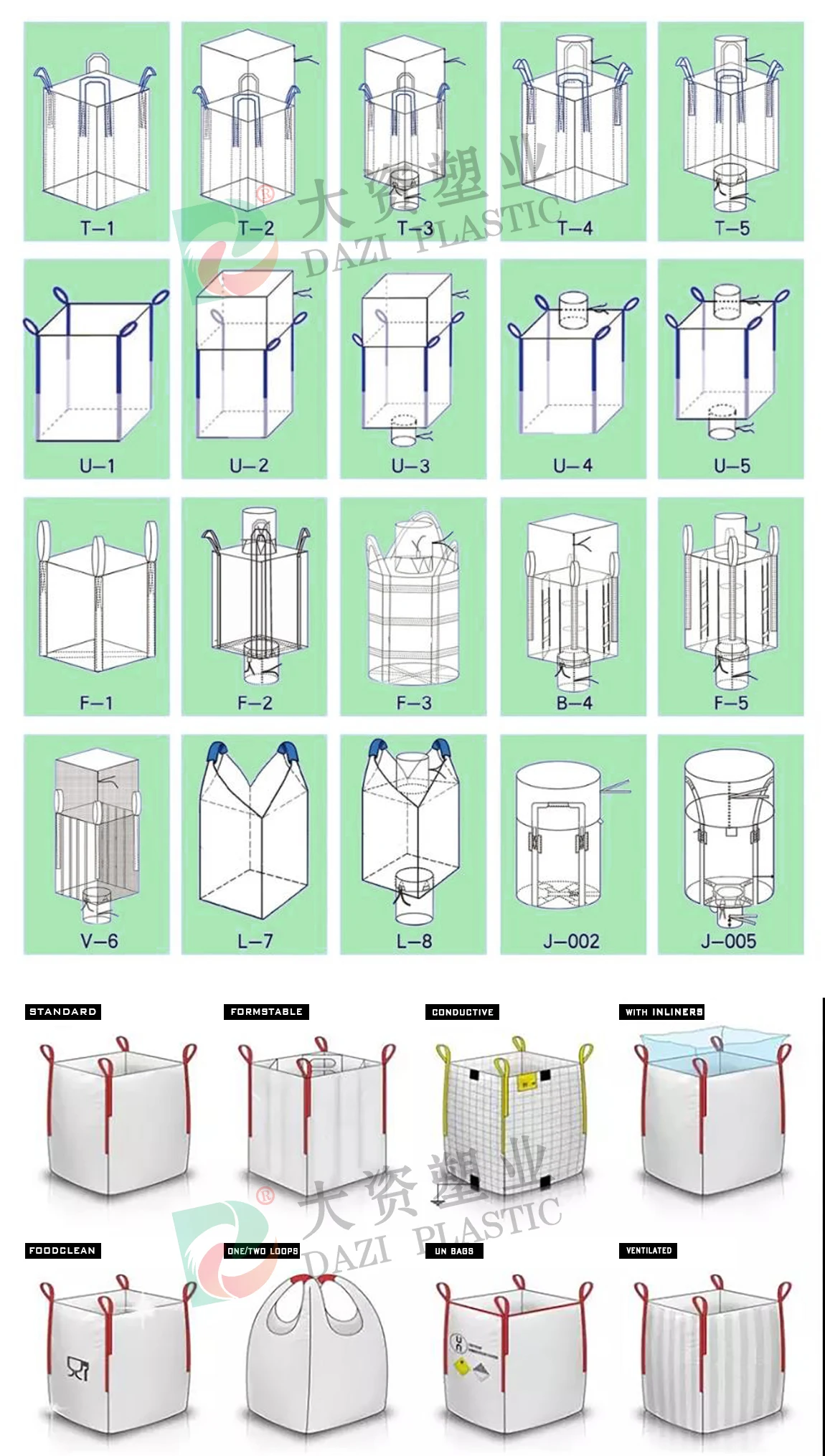
All hazardous chemical bulk materials must adopt UN-certified FIBCs with matched packaging groups (X/Y/Z) based on hazard level. Flammable powder and dust-prone chemical materials require Type C grounded or Type D ground-free anti-static FIBCs to eliminate static spark risks during filling and vibration transportation. For corrosive chemical granules and hygroscopic chemical powders, select coated anti-corrosion fabrics and chemical-resistant thickened liners to prevent fabric corrosion and material deliquescence.
Different from ordinary industrial bags, chemical FIBCs need stable low-temperature resistance to avoid fabric brittleness and cracking in cold storage environments, and complete permanent marking for dangerous goods logistics traceability.
Scenario 3: Construction & Abrasive Mineral Bulk Transport
Construction and mineral materials including quartz sand, cement powder, gravel aggregates, ore particles and refractory powder are typical high-abrasion, high-density bulk cargoes. The biggest challenge for FIBCs in this scenario is mechanical friction damage and local puncture rupture. Wear resistance, puncture resistance and high load stability are the top selection indicators.
Prioritize high-density thickened woven PP fabrics and bottom local reinforcement design. The bottom bearing area, which bears the most friction during forklift handling and ground dragging, adopts double-layer or multi-layer encrypted stitching to resist continuous scouring of sharp mineral particles. Adopt 6:1 high safety factor structural design to adapt to high-density heavy-load stacking and bumpy road transportation.
Cement and other easy-bridging powder materials require optimized large-caliber discharge spout and anti-blocking structural design to avoid material agglomeration and unsmooth discharging. For outdoor stockpiled building materials, add UV-stabilized anti-aging formulas to extend service life under long-term sunlight exposure.
Scenario 4: General Industrial Plastic & Resin Pellet Turnover
Plastic particles, resin pellets, rubber granules and industrial filler particles belong to low-risk, low-abrasion and stable inert bulk materials. This scenario pursues balanced cost performance, neat shaping and stable turnover efficiency, avoiding over-specification waste.
Ordinary medium-duty uncoated or lightly coated FIBCs are sufficient for indoor factory turnover and short-distance transportation. Adopt U-panel cubic shaping design to standardize filled bag shape, improve container loading rate and warehouse stacking neatness. Since resin pellets are prone to tiny gap leakage, select encrypted weaving technology to prevent fine particle seepage without redundant fully sealed liner configuration.
For repeated internal turnover of plastic raw materials, choose reusable high-fatigue FIBCs to reduce long-term procurement costs, matching medium safety factor parameters to meet daily handling and stacking demands.
Scenario 5: Agricultural Bulk Material Storage & Logistics
Agricultural bulk products such as grain, seeds, fertilizer pellets and feed materials have prominent characteristics of moisture sensitivity and ventilation demand. The core selection factors arebreathable balance, mildew resistance and anti-pollution.
Grain and seed materials need breathable woven structures to discharge internal heat and condensed water, preventing grain mildew and seed germination during storage. Avoid fully sealed non-breathable designs that cause internal stuffy dampness. For chemical fertilizer bulk materials with hygroscopic and corrosive properties, adopt coated waterproof fabrics and targeted anti-static configurations to prevent static-induced chemical reaction risks.
Agricultural FIBCs prioritize lightweight and flexible design to adapt to frequent manual and mechanical cooperative handling in farmland and grain depots, while meeting outdoor temporary stacking weather resistance requirements.
Key Parameter Comparison for Quick Scenario Matching
To simplify on-site selection judgment, core configuration differences for mainstream industrial scenarios are summarized as follows:
-
Food & Pharma: Food-grade material + fully sealed liner + dust-free structure + hygiene certification
-
Chemical Hazardous Goods: UN certification + anti-static grade + anti-corrosion liner + dangerous goods marking
-
Mineral & Construction: Thickened wear-resistant fabric + reinforced bottom + 6:1 high safety factor + UV resistance
-
Plastic Resin Pellets: Encrypted anti-leakage weaving + cubic shaping + cost-effective medium-duty structure
-
Agricultural Products: Breathable woven structure + waterproof coating + mildew-proof and anti-corrosion design
Common Selection Mistakes Across Industrial Scenarios
Many enterprises rely on unified fixed specifications for all bulk cargoes, leading to hidden losses. Using ordinary non-certified FIBCs for food and chemical materials causes compliance risks; adopting thin standard bags for abrasive minerals leads to high damage rates; applying fully sealed heavy-duty bags for common particles results in serious cost overrun; ignoring UV anti-aging design for outdoor storage leads to rapid fabric failure.
The correct selection logic is to take scenario demand as the core, match material performance, structural design and certification standards in a targeted manner, and realize precise customization from safety, functionality and cost dimensions.
Conclusion
Industrial bulk cargo FIBC selection is not based on unified high-spec configuration or single low-price judgment, but on systematic matching of material characteristics, application scenarios and industrial standards. Food and pharmaceutical scenarios focus on hygiene and sealing, chemical scenarios emphasize safety compliance and static protection, construction and mineral scenarios prioritize wear resistance and load stability, plastic pellet scenarios focus on cost performance and shaping effect, and agricultural scenarios value ventilation and moisture-proof performance. Mastering these scenario-based key selection factors can help industrial users eliminate safety hazards, reduce material and packaging losses, and maximize the comprehensive cost-effectiveness of bulk cargo packaging and logistics.